Showing posts with label classic. Show all posts

No Promises in the Wind Review

No Promises in the Wind
Average Reviews:

(More customer reviews)
The book No Promises in the Wind by Irene hunt was about a young boy's struggle to survive during the depression in the U.S. It takes place during the winter of 1932. Josh is the main character in the book. He and his father Stefan always get into arguments because his father has no job and can't provide for his family, so his father takes his frustration out on his on Josh, his oldest son. This causes Josh to leave home and embark on his adventure. His mother Mary is the one that gives Josh the OK to leave home. She feels bad for doing this, but she only sees the situation getting worse. So, Howie and Josh decide to run away together and make a life for themselves. Howie is Josh's best friend. Just before they leave, Josh's little brother wants come along. His name is Joey. Joey is ten years old and looks like an angel. There many problems that the main characters encounter during the book, the first one happens when the brothers lose their friend. Howie is run over by a train in the beginning of the book. After this, the main problem is to get money and food. Different people help Josh and Joey get food. One day while walking, they meet a truck driver named Lonnie. Lonnie is very helpful; he gives the boys meals and a long ride down south to warmer weather. He also helps Josh find a job at a carnival. At the carnival Josh and Joey meet Emily. She is an older lady. She is very kind to the boys. Josh falls in love with her, but it does not work out because of the age differences. The carnival burns down so the boys head back north to find their friend Lonnie. Along the way they have to beg to survive.
The one character that I could relate to was Josh. Because I have had similar conflicts with my father. Like Josh's father, my dad was going through hard times and most of the time took out his frustration on me. At times I wanted to leave, but I did not. My father and I worked out our problems like Josh and his father did.
I really enjoyed this book. It keeps the reader entertained the whole time. You always want to find out what is going to happen to the boys all the way to the end. My favorite part is when the boys are at the carnival. The author does a good job of describing the people and events that happen during their stay at the carnival. My least favorite part was when the man at the shoe store took the boy's money. Personally I would not change anything to this book. I think it was written well, and it gets its point across.
I would recommend this book to any one who is interested in how life was during the 1930s. Also anyone that grew up during that time period might enjoy it. This book is a fun read that keeps you entertained the whole time.

Click Here to see more reviews about: No Promises in the Wind

In 1932, America was in the depths of a deep depression. A job, food to fill you, a place to sleep, and shoes without holes--for millions of people, these simple needs were nothing more than dreams. At 15 years of age, Josh had to make his own way through a country of angry, frightened people. This is the story of a young man's struggle to find a life for himself in the turbulent 1930s.

Buy Now

Click here for more information about No Promises in the Wind

Read More...

The Books at the Wake: A Study of Literary Allusions in James Joyce's Finnegans Wake Review

The Books at the Wake: A Study of Literary Allusions in James Joyce's Finnegans Wake
Average Reviews:

(More customer reviews)
Atherton's book is "absotively" wonderful. Appreciating the Wake certainly requires this book. Numerous linguistic influences on Joyce from various authors are catalogued. Particularly interesting is the lengthy analysis of Lewis Carroll's literary influence on Joyce:
1. Carroll is presumably the undisputed inventor of the portmanteau word - a word packed with multiple meanings. Carroll was content to have dual meaning but Joyce packed as many meanings as possible into his words.
2. Carroll (like Joyce) worked with successive alterations of one letter in a word - meat, meet, mate, maze, etc. Sections of the Wake which obliquely referenced Carroll would routinely incorporate this technique.
3. Alice served as an alterego for Joyce's heroine ALP, where "Wonderlawn" is code for the Garden of Eden.
In short, Joyce found much in Carroll's work that (in the case of the portmanteau word, to his surprise) neatly "dovetallied" with his own "work in progress". The Books at the Wake is a fascinating and well-written collection of many more such analyses (Shakespeare, Blake, Vico, etc.).

Click Here to see more reviews about: The Books at the Wake: A Study of Literary Allusions in James Joyce's Finnegans Wake

In Finnegans Wake Joyce uses world lit­erature, great and small, sacred and pro­fane, as one of the most important and frequent of his sources. Setting out to ex­plore these literary allusions, Mr. Atherton sheds a great deal of light upon other as­pects of Joyce's work. Entire chapters are devoted to such major figures as Swift and Lewis Carroll, while less important influences are grouped together under such headings as "The Irish Writers" and "The Fathers of the Church." He also sur­veys the various interpretations of Finnegans Wake, and makes use of the Letters of James Joyce and the manuscript of Fin­negans Wake in the British Museum.

Buy Now

Click here for more information about The Books at the Wake: A Study of Literary Allusions in James Joyce's Finnegans Wake

Read More...

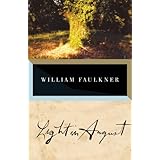
Light in August (The Corrected Text) Review

Light in August (The Corrected Text)
Average Reviews:

(More customer reviews)
After reading Faulkner's four major masterpieces -- The Sound and the Fury; Absalom, Absalom!; As I Lay Dying; and Light in August -- I've come to the conclusion that Light in August is far and away the easiest to read, has the most dramatic plot, the most intriguing primary characters in Joe Christmas, Gail Hightower and Joanna Burden, and even some of his most intriguing minor characters in Uncle Doc Hines and Mr. McEachern. Overall, it is his most readable and likeable masterpiece. And it leaves you wanting so much more.
The complex and ambiguous character of Joe Christmas alone could have been the source of three or four novels detailing different times in his life. While Christmas is hardly a likeable person, he is fascinating, hypnotic, a train wreck; you can't keep your eyes off him. His actions are morally ambiguous and inconsistent and yet fully understandable within his nature. As a creation he deserves to rank with Huck Finn, Tom Sawyer, Captain Ahab and Jay Gatsby in the pantheon of American literary characters.
Faulkner has a big mission here. The novel exposes the evils of racism both in the South and among white, northern abolitionists. It traffics in religious symbolism while savaging religious fanatacism. And it leaves one with a great deal of memorable violent and sexual imagery. And that's just for starters. This book is deep, and while it's storytelling is largely non-linear, it is far more palatable than the other three, which tend to be confusing and obscure. Enjoy this one. If you've never read Faulkner, it's a great starter.

Click Here to see more reviews about: Light in August (The Corrected Text)


Buy NowGet 38% OFF

Click here for more information about Light in August (The Corrected Text)

Read More...

The Godfather Classic Quotes Review

The Godfather Classic Quotes
Average Reviews:

(More customer reviews)
This book has been a long time coming. One of the absolute greatest movies of all time has been quoted in all it's glory. Each of the classic lines are here from "Fredo you're my older brother" to "Luca Brasi sleeps with the fishes!" Each page is elegantly illustrated and some quotes even reference their refering shot from the actual film. No true Godfather fan should be with out this classic addition to the original work.

Click Here to see more reviews about: The Godfather Classic Quotes

Francis Ford Coppola's The Godfather is one of the greatest movies of all time and one of the most popular: on its 35th anniversary, it continues to be a top earner on video and DVD. But what has made this classic so compelling is the unique Corleone wit and wisdom. Every fan will want to own this officially licensed, completely fascinating anthology of memorable words from the film. It features a great selection of famous quotes from the "Family," from the Don's unforgettable "I'm gonna make him an offer he can't refuse" to Clemenza's infamous, "Leave the gun. Take the cannolis." Every sharp and witty line will bring back a memory of this great movie—and that makes it a perfect gift for every Godfather aficionado. Who would dare to resist? TM & © 2007 Paramount Pictures. All Rights Reserved.

Buy NowGet 27% OFF

Click here for more information about The Godfather Classic Quotes

Read More...

Lord of the Flies (50th Anniversary Edition) Review

Lord of the Flies (50th Anniversary Edition)
Average Reviews:

(More customer reviews)
"Lord of the Flies" is singularly the most important novel for required reading, whether assigned in school or self-imposed. It regularly appears as number one on my own list of best books.
Let's play "What if." What if a plane carrying a full load of school boys crashes on a deserted island with no adult survivors? What would happen to those boys? What would you expect to happen?
William Golding works with this premise: an idyllic setting, innocent schoolboys. One boy, an older boy just short of teenage years, a boy with fair hair, assumes leadership to stir the others into some semblance of organization and survival mode, much like adults would do if adults were present. He also saw a need to defuse the web of fear of the younger ones. Where are we? How long will we need to wait before someone comes for us? All questions with no answers at this time.
Ah, yes, Golding tells us, everything goes well for a while. But remember the "scar" made by the crashing plane? Something ugly is on this island (but it's not the scar). It's in the bushes, in the dark, in the depths, in the depths of hearts, and it grows like the malignancy it is.
A blatant revelation of what is about to come occurs when Roger silently and stealthily watches a young'un, unbeknownst to the little child. All the young'un is doing is running a stick through the sand, disturbing a crab in a tiny pool of water. Even he imposes control and fear on a helpless creature as Roger boldly picks up a couple of rocks and tosses them the youngster's way. He deliberately misses but comes closer with each throw. Next time he will probably hit the young boy, but not yet. This taboo--deliberately and unnecessarily causing pain to one smaller than you--has not been broken--yet.
Although the dance of the spears, the primeval chants, the attack and killing of the pig, then feasting on its flesh, their kill, are shocking acts of savagery, this event is foreshadowed by the seemingly innocent lob of the stones. From a casual incident, but one with eventual intentionality, the ritualistic slaughter is not so far-fetched or surprising. Golding prepares his readers. This is how the chaos of society starts. It begins with one simple disconnect from the rules. It begins in the minds and hearts. Will I do what society expects? Will I follow the rules to keep things running and working? Do I break a rule or two for my own enhancement. Will I feel a power surge if my rock hits that young `un?
Ralph would probably speak of the terror of knowing that rules WILL be broken. He would speak of the utter horror that any rule can be and will be broken and he won't live to tell about it. Just ask Piggy.
This novel is the only one I taught over and over during the twelve years I worked with high school seniors. My other choices I would switch around those years, drop some, add some. This one I kept. It is that important. I think of "Lord of the Flies" as a necessary manual for societal behavior and an effort to keep the chaos of evil at bay.
Is it even necessary to ask how many times that rock has been thrown since this novel was published in the 1950's? Or how much chaos has imploded so many lives?
Like the way of manuals, some remain in circulation and are deeply read; others fall by the wayside out of disinterest. Some are thrown in the trash. "Lord of the Flies"--what is its current status? And society--how is it doing? Reader, are you a little bit fearful?


Click Here to see more reviews about: Lord of the Flies (50th Anniversary Edition)


Buy NowGet 34% OFF

Click here for more information about Lord of the Flies (50th Anniversary Edition)

Read More...

The Catcher in the Rye Review

The Catcher in the Rye
Average Reviews:

(More customer reviews)
In J.D. Salinger's brilliant coming-of-age novel, Holden Caulfield, a seventeen year old prep school adolescent relates his lonely, life-changing twenty-four hour stay in New York City as he experiences the phoniness of the adult world while attempting to deal with the death of his younger brother, an overwhelming compulsion to lie and troubling sexual experiences.
Salinger, whose characters are among the best and most developed in all of literature has captured the eternal angst of growing into adulthood in the person of Holden Caulfield. Anyone who has reached the age of sixteen will be able to identify with this unique and yet universal character, for Holden contains bits and pieces of all of us. It is for this very reason that The Catcher in the Rye has become one of the most beloved and enduring works in world literature.
As always, Salinger's writing is so brilliant, his characters so real, that he need not employ artifice of any kind. This is a study of the complex problems haunting all adolescents as they mature into adulthood and Salinger wisely chooses to keep his narrative and prose straightforward and simple.
This is not to say that The Catcher in the Rye is a straightforward and simple book. It is anything but. In it we are privy to Salinger's genius and originality in portraying universal problems in a unique manner. The Catcher in the Rye is a book that can be loved and understood on many different levels of comprehension and each reader who experiences it will come away with a fresh view of the world in which they live.
A work of true genius, images of a catcher in the rye are abundantly apparent throughout this book.
While analyzing the city raging about him, Holden's attention is captured by a child walking in the street "singing and humming." Realizing that the child is singing the familiar refrain, "If a body meet a body, comin' through the rye," Holden, himself, says that he feels "not so depressed."
The title's words, however, are more than just a pretty ditty that Holden happens to like. In the stroke of pure genius that is Salinger, himself, he wisely sums up the book's theme in its title.
When Holden, whose past has been traumatic, to say the least, is questioned by his younger sister, Phoebe, regarding what he would like to do when he gets older, Holden replies, "Anyway, I keep picturing all these little kids playing some game in this big field of rye and all. Thousands of little kids, and nobody's around--nobody big, I mean--except me. And I'm standing on the edge of some crazy cliff. What I have to do, I have to catch everybody if they start to go over the cliff--I mean if they're running and they don't look where they're going. I have to come out from somewhere and catch them. That's all I'd do all day. I'd just be the catcher in the rye and all. I know it's crazy, but that's the only thing I'd really like to be."
In this short bit of dialogue Salinger brilliantly exposes Holden's deepest desire and expounds the book's theme. Holden wishes to preserve something of childhood innocence that gets hopelessly lost as we grow into the crazy and phony world of adulthood.
The theme of lost innocence is deftly explored by Salinger throughout the book. Holden is appalled when he encounters profanity scrawled on the walls of Phoebe's school, a school that he envisions protecting and shielding children from the evils of society.
When Holden gives his red hunting cap to Phoebe to wear, he gives it to her as a shield, an emblem of the eternal love and protectiveness he feels for her.
Near the beginning of the book, Holden remembers a girl he once knew, Jane Gallagher, with whom he played checkers. Jane, he remembers, "wouldn't move any of her kings," and action Holden realizes to be a metaphor of her naivete. When Holden hears that his sexually experienced prep school roommate had a date with Jane, he immediately starts a fight with him, symbolically protecting Jane's innocence.
More sophisticated readers might question the reasons behind Holden's plight. While Holden's feelings are universal, this character does seem to be a rather extreme example. The catalyst for Holden's desires is no doubt the death of his younger brother, Allie, a bright and loving boy who died of leukemia at the age of thirteen. Holden still feels the sting of Allie's death acutely, as well as his own, albeit undeserved, guilt, in being able to do nothing to prevent Allie's suffering.
The only reminder Holden has of Allie's shining but all-too-short life, is Allie's baseball mitt which is covered with poems Allie read while standing in the outfield. In a particularly poignant moment, Holden tells us that this is the glove he would want to use to catch children when they fall from the cliff of innocence.
In an interesting, but trademark, Salinger twist, Holden distorts the Robert Burns poem that provides the book's title. Originally, it read, "If a body meet a body, comin' through the rye." Holden distorts the word "meet" into "catch." This is certainly not the first time Holden is guilty of distortion; indeed he is a master at it.
This distortion, however, shows us how much Allie's death has affected Holden and also how much he fears his own fall from innocence, the theme that threads its way throughout the whole of the book.
By this amazing book's end, we must reach the conclusion that there are times when we all need a "catcher in the rye." We are, indeed, blessed if we have one.

Click Here to see more reviews about: The Catcher in the Rye


Buy NowGet 46% OFF

Click here for more information about The Catcher in the Rye

Read More...

1001 Smartest Things Ever Said Review

1001 Smartest Things Ever Said
Average Reviews:

(More customer reviews)
This book contains some of the funniest things I've ever read. It's so good to read because it makes me laugh at some of the things people say. If you want to be entertained and made laugh this book is perfect. It's a real treasure of funny sayings. I laughed so much I could not see the words.

Click Here to see more reviews about: 1001 Smartest Things Ever Said


Buy Now

Click here for more information about 1001 Smartest Things Ever Said

Read More...

From Here to Eternity Review

From Here to Eternity
Average Reviews:

(More customer reviews)
I was in the U.S. Army for four years, '67-71. During those years, I did not read Jones, Mailer, or any other military-related novels. I was able to do so a couple of years later. From Here To Eternity struck me as no other novel had. Jones absolutely captured the depravity, decency, tenderness, and brutality of what it is to be a soldier. No one has ever done it better. I read the last page on a bus, and still feel the loss of it ending. I wish it had continued. As good as the other two books in the trilogy, Thin Red Line and Whistle, they do not approach the depth and truth of From Here to Eternity. One of the few great american novels.

Click Here to see more reviews about: From Here to Eternity


Buy NowGet 32% OFF

Click here for more information about From Here to Eternity

Read More...